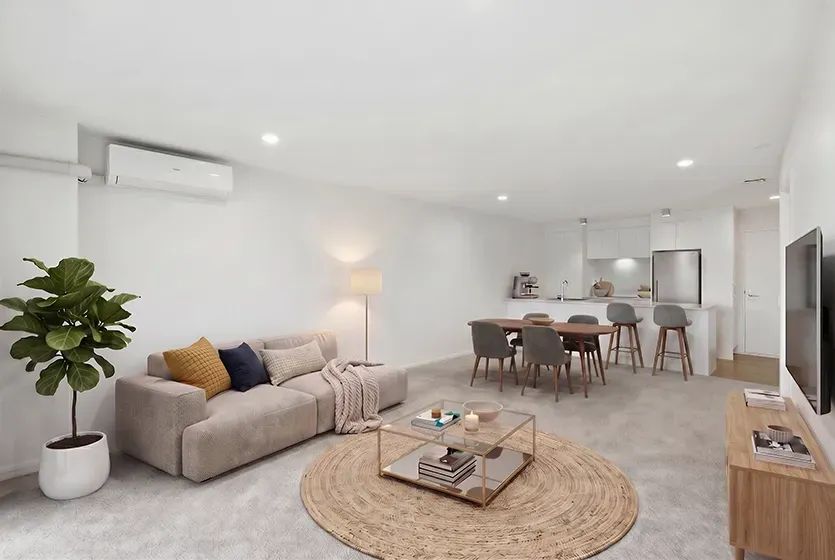
Is Home Staging Worth It? The Evidence for Sellers
Staging costs money, and every vendor asks the same fair question: does it actually change what the house sells for, or does it just make the photos look nicer?
It is worth answering honestly, because the answer is not always yes. Staging is worth it for most listings, but not all — and there is now a far cheaper way to get most of the benefit. Here is what the evidence points to, and how to decide for a specific property.
What staging is actually trying to do
Before the numbers, it helps to be clear on the mechanism. Staging is not decoration for its own sake. It does three specific jobs.
It helps buyers visualise living there. An empty room gives a buyer nothing to react to; a styled room shows scale, function and a life they can picture. In the National Association of Realtors' Profile of Home Staging, 83% of buyers' agents said staging made it easier for a buyer to envision a property as their future home.
It wins attention online. Most buyers start on Trade Me and realestate.co.nz, and styled hero images hold the eye longer than empty rooms. More attention means more enquiries, which means more competition.
And it signals care. A well-presented listing reads as a home that has been looked after, which quietly supports the price.
What the evidence says about price and time on market
The honest position is that staging's effect is well supported in direction, even if exact figures vary by study and market.
The clearest data comes from the United States, where the National Association of Realtors surveys agents each year. In its Profile of Home Staging, almost half (49%) of sellers' agents reported that staging reduced the time a home spent on the market, and nearly three in ten (29%) said it increased the dollar value buyers offered — typically by 1% to 10%. New Zealand doesn't have an equivalent national dataset, but the mechanism is the same here: staged homes tend to sell faster and attract stronger competition than comparable unstaged ones. The size of that effect depends on the property, the market and how well the staging is done — it is a lever, not a guarantee.
A sensible way to read it: staging rarely hurts a sale, often speeds it up, and on the right property can add more to the price than it costs. That asymmetry is why so many agents recommend it.
When staging is clearly worth it
Staging earns its cost most reliably when:
the property is vacant, so buyers have nothing to anchor to
the home is average or awkward in layout and needs help showing how rooms work
the listing sits in a competitive segment where presentation is the tiebreaker
the open home is central to the campaign and you need the in-person experience to land
In those cases, the cost of staging is small next to the risk of a slow, under-competed campaign.
When it may not be
Staging is not a universal yes.
If the home is already beautifully furnished and presents well, the marginal benefit is smaller. If the property will sell quickly regardless — a hot location, a development site, a tightly held street — staging may add little. And if the budget is genuinely tight, spending thousands on physical staging can be the wrong call when a cheaper option exists.
That last point is where most vendors get stuck: they believe in staging but cannot justify the cost. They no longer have to.
The cheaper way to get most of the benefit
Most of staging's value shows up in the photos — and you can get styled photos without hiring any furniture.
Virtual staging digitally furnishes the listing images, giving buyers the same "I can see myself here" reaction online at a fraction of the cost of physical staging, usually delivered within 24 hours. For a vacant or tenanted home where the online first impression is what matters, it captures most of the upside for a small slice of the spend. The full cost comparison is in our guide to home staging cost in Auckland.
It does not replace physical staging where the open home is doing the selling. But for the vendor who believes in staging yet baulks at the price, it changes the maths entirely.
So, is it worth it?
For most Auckland listings, yes — staging is worth it, because it speeds up the sale and protects the price more often than not. The real decision is which kind of staging fits the property and the budget: physical staging when the open home is central, virtual staging when the online presentation is what counts.
If you want to weigh it up for a specific listing, start with the virtual staging service or read the full home staging vs virtual staging comparison.
FAQs: is home staging worth it?
Does home staging actually increase the sale price?
The evidence points in that direction. Staged homes tend to sell faster and attract more buyer competition, which helps protect or lift the final price. The effect varies by property and market, so staging is best seen as a lever that improves the odds rather than a guaranteed dollar return.
Is staging worth it for a home that will sell easily anyway?
Often not. If the property is in high demand or already presents beautifully, the marginal benefit of staging is smaller. Staging does its strongest work on vacant, average or awkward homes in competitive segments.
Is virtual staging worth it compared to physical staging?
For online-led campaigns, frequently yes. Virtual staging delivers most of the visual benefit — buyers picturing themselves in the space — at a fraction of physical staging's cost. Physical staging still wins when the open home experience is central to the sale.
How much does staging cost in Auckland?
Physical staging typically runs $2,000–$5,000+ depending on the property, while virtual staging is priced per image or per room for a fraction of that. See our full breakdown in the home staging cost guide.