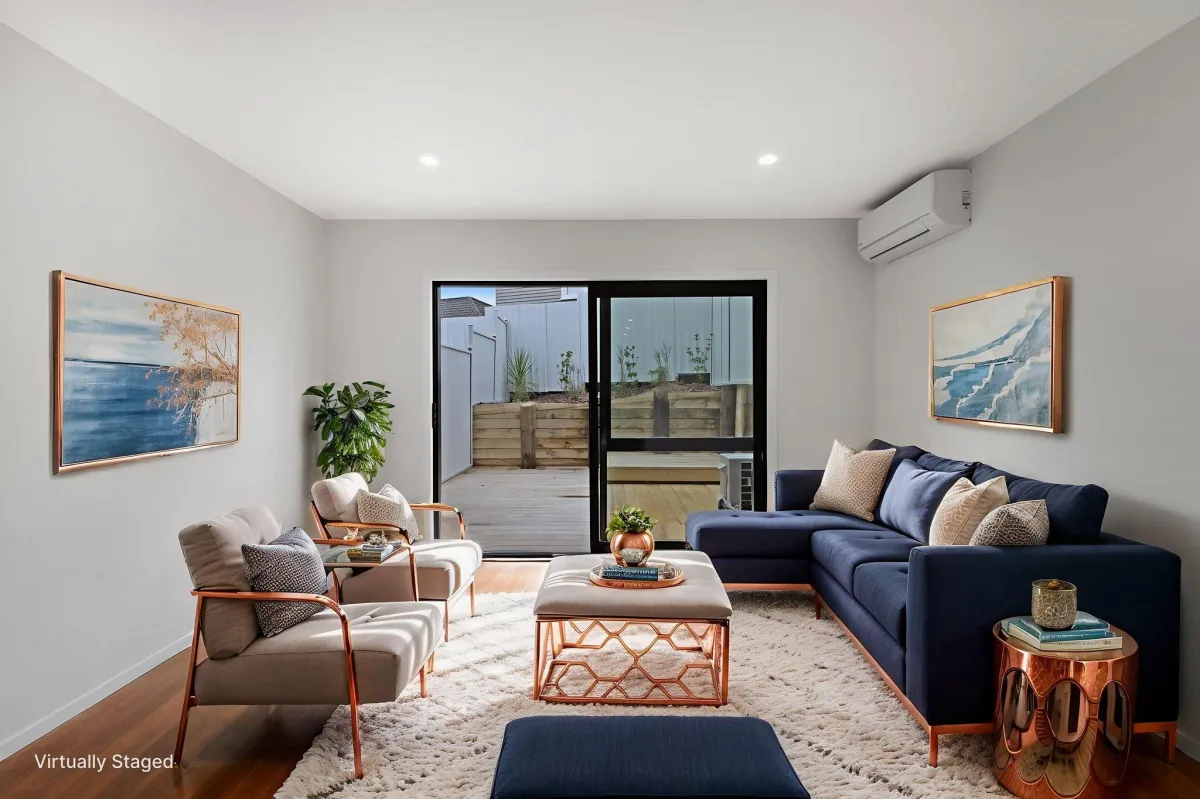
Home Staging vs Virtual Staging: Auckland Guide
Every listing is different. The question isn't really "physical staging or virtual staging?" Rather, it's "what does this property actually need to present at its best?"
The answer to that question sits on a spectrum. At one end is a vendor whose home is already beautifully presented and just needs a photographer. At the other is a vacant property that needs a full lifestyle story created from scratch. Most listings fall somewhere in between, and the best agents read each situation on its own terms rather than defaulting to a single approach.
This guide walks through the five staging options available to Auckland agents in order of intervention (from least to most) with guidance on when each one is the right call.
There are currently 29 weeks of stock on the Auckland market (Opes Partners), well above the long-term median of 22 weeks. Properties are averaging 49 days to sell, compared to the historical norm of 37. In that environment, presentation isn't optional — but it doesn't always need to be expensive or complicated. The goal is always the same: give buyers enough visual and emotional information online to want to step through the door, then give them an in-person experience that confirms the decision.
Option 1: The Vendor's Home Is Already There
Sometimes the best staging decision is to recognise that no staging is needed.
There are vendors who have spent years living in a home with a genuine eye for presentation. Their furniture is well-chosen, appropriately scaled, and in keeping with the property's architecture. Their rooms are considered rather than cluttered. Their home photographs the way it looks, and the way it looks is good.
In these situations, the agent's job is straightforward: walk through the property, confirm it's ready, and book the photographer. Adding staging of any kind to a home that's already presenting well introduces unnecessary cost and, in some cases, a homogenised look that strips the property of the very character that makes it appealing.
The practical test is to stand in each room and ask: does this space tell a clear, positive story about how life could be lived here? If yes, then it is ready to photograph. The vendor's investment in their home over the years is doing the work.
When this applies: owner-occupied properties where the vendor has a strong visual sensibility, homes with considered interiors that reflect the property's architectural style, listings where the current furnishings genuinely match the target buyer demographic.
Option 2: Work With the Vendor to Prepare the Property
This is the most underused option in Auckland real estate, and often yields the highest-return.
Many vendors occupy homes that have good bones, appropriate furniture, and real lifestyle appeal, but those qualities are hidden behind layers of accumulated living. Cluttered surfaces, excess furniture, personal items in every frame, rooms being used for purposes that don't photograph well. The property has everything it needs to present beautifully. It just needs to be edited.
The agent's role here is to become a practical guide. Walk through the property with the vendor before the shoot. Identify what stays and what goes. Surfaces cleared of personal items. Excess furniture moved into temporary storage for the campaign duration. Minor repairs addressed. The rooms that remain are the rooms that should be photographed.
This approach costs the vendor a storage unit hire and some effort. What it returns is a home that photographs as a clean, liveable, well-maintained property — not an empty shell, not an artificially staged environment, but an honest and appealing version of what it actually is. Buyers who attend open homes experience exactly what they saw online, which builds trust and reduces the disappointment gap that can occur with other staging approaches.
This article on preparing a home for photography, is a great resource to help vendors prepare their home for sale, covering exactly what to address before a shoot. The declutter-and-store approach works particularly well when:
The vendor's furnishings are appropriate but the volume is too high
Personal items dominate the visual field in photography
Rooms are being used in ways that obscure their primary function — a bedroom doubling as a home office, a dining room used for storage
The property has strong natural light and good proportions that are being masked by visual clutter
When this applies: owner-occupied homes with appropriate furniture that simply needs reducing, vendors who are willing to invest time in preparation, properties where the underlying architecture and layout is strong.
Option 3: Physical Staging
When the vendor's furniture can't do the job because the property is vacant, the furnishings are dated or mismatched, or the style is actively working against the listing, professional physical staging is the most complete solution available.
A physical stager visits the property, selects furniture and accessories from their inventory, and styles the home to present at its best for both photography and in-person viewings. The furniture remains in place for the campaign duration, typically four to six weeks.
The critical advantage physical staging holds over every other option on this list is the in-person experience. According to the 2025 NAR Profile of Home Staging, 83% of buyers' agents said home staging makes it easier for buyers to visualise the property as a future home. When a buyer walks through a physically staged property, they experience the scale of the rooms, the warmth of the environment, and the lifestyle the stager has created. That three-dimensional emotional response is something no photograph can fully replicate — and for certain listings it's decisive.
What it costs in Auckland
Physical staging in Auckland currently starts at around $2,100 for a studio. A one-bedroom apartment runs approximately $2,399 and a two-bedroom unit around $2,599 for a standard four to five week hire. Three and four-bedroom homes typically fall in the $3,500–$5,500 range depending on the stager and scope. Extensions beyond the standard hire period add weekly fees.
Against Auckland's current median sale price of $950,000, a 3% improvement in sale price — a figure consistently supported by staging research internationally — represents $28,500. The ROI case for physical staging is sound when the property genuinely benefits from the in-person experience it creates.
Where physical staging earns its cost
Premium properties where the in-person impression is central to achieving asking price. Properties with unusual layouts or spaces that need to be physically defined for buyers to understand how they function. Listings where emotionally driven buyer competition is expected — family homes, character properties, premium coastal properties — and where the open home experience needs to match the online impression completely.
The staging style matters
Auckland's property stock is varied enough that staging style decisions matter. A 1920s character villa in Grey Lynn needs warm tones and period-appropriate furnishings that honour the home's original features. A contemporary townhouse in Hobsonville or Flat Bush calls for clean lines and minimal styling that resonates with first-home buyers. A coastal home on the North Shore looks for the light-filled, relaxed aesthetic Auckland buyers associate with waterfront living. A stager who applies a generic look regardless of property type is leaving value on the table.
When this applies: vacant properties at the premium end of the market, prestige listings where in-person experience is critical to price achievement, properties with layout or architectural features that need to be physically demonstrated.
Option 4: Virtual Staging
Virtual staging produces the same photographic outcome as physical staging, showcasing rooms that look fully furnished and styled in listing photos, but entirely through professional editing rather than physical furniture.
Photos of the empty or existing space are taken first. Editors then digitally add furniture, soft furnishings, artwork, and décor to each selected room, producing photo-realistic images. Here at Bash & Co, we deliver these within 24 hours. There is no furniture to source, transport, install, or remove. There is no scheduling coordination. In practice, the listing could go live the day after the photography session.
Virtually staged photos generate 40% more online views and inquiries compared to unstaged listings. In a market where the buyer journey begins online and most serious buyers have shortlisted properties before attending a single open home, that digital performance advantage is significant.
What it costs
Here at Bash & Co, virtual staging starts from $30 per room for individual rooms and from $280 for a full home package for properties with three bedrooms or fewer. The cost is fixed and one-off. There are no extension fees regardless of how long the campaign runs.
The open home consideration
The limitation with virtual staging is the in-person experience gap. Buyers who have engaged with staged photography online arrive to an empty property. For some listings this doesn't matter so much, like with buyers researching investment properties or new builds. They are accustomed to visualising from photographs. For family homes where the emotional connection at the open home is a critical part of the sale process, the gap between the online impression and the in-person reality needs to be actively managed.
The practical solution is straightforward and underused: bring high-resolution printed copies of the virtually staged images to every open home. Often, agents will already have these materials available like with printed trifolds. Place them in close to the entry and hand these out to buyers before they start walking through the property. Showing buyers the staged version of each space while they're standing in it directly bridges the visualisation gap. Some agents use a tablet for the same purpose. It's a small logistical step that makes a meaningful difference to the in-person experience.
Where virtual staging earns its place
Virtual staging is the right call when speed, cost, or practicality makes physical staging unworkable. That covers a lot of ground including vacant properties that need to go live quickly, investment and rental properties where the buyer's primary research happens online, and any listing where the vendor's budget is the deciding factor but the photography still needs to tell a compelling story. If the property needs to perform digitally and the in-person gap can be managed, virtual staging delivers that outcome without the logistics or the cost.
The new build and development use case
For Auckland's townhouse and development market, a targeted hybrid approach delivers the best of both worlds. Rather than physically staging every unit, which is prohibitively expensive and logistically complex across a multi-unit development, stage one or two units physically to give buyers the full in-person experience. Then virtually stage the remaining units for the online listing, so every home in the development has a complete lifestyle story in its photography.
For open homes and private viewings, the agent walks buyers through the physically staged unit first to create the emotional connection and give them a true sense of scale, flow, and finish. The virtually staged images of the other units are then used to show buyers what each variant looks like furnished as they walk through the empty units. Buyers leave having felt the lifestyle in person and seen every floor plan presented at its best online. It's a more compelling campaign than physical staging alone could deliver, at a fraction of the cost of furnishing every unit.
When this applies: vacant properties at any price point, new builds and developments, tenanted properties where virtual decluttering and staging can transform the photography without disrupting the occupant, properties where digital marketing performance is the primary objective.
Option 5: The Hybrid Approach
The hybrid approach is the most practical option for the large middle ground of Auckland listings, where online performance and the in-person experience matters, but the vendor's budget or situation doesn't support full physical staging throughout.
The hybrid uses physical staging selectively for the rooms that create the strongest emotional impact at open homes, and virtual staging for everything else in the online listing.
In practice this typically means physically staging the living area and master bedroom — the two rooms where buyers spend the most time and form the strongest emotional impressions — and using virtual staging for secondary bedrooms, the dining area, and any other spaces that benefit more from online presentation than in-person atmosphere.
The living room is the right place to invest in physical staging. It's where buyers pause longest during an open home, where they have the most time to imagine themselves living in the space, and where a skilled stager can create the warmth and scale that photographs alone don't fully convey. The master bedroom is a close second. It's personal, emotional, and aspirational in a way that benefits from physical presence.
Virtual staging can be leveraged with everything else, like secondary bedrooms used as offices or guest rooms, smaller spaces, and areas that present cleanly but don't need the full emotional weight of physical staging.
This approach gives the online listing a fully staged appearance across all rooms, provides buyers with the physical staging experience in the spaces that matter most at the open home, and keeps the total cost significantly below a full physical staging investment.
When this applies: mid-market Auckland properties where in-person experience matters but full physical staging isn't warranted, campaigns where the vendor wants to present well online and in person but is managing costs carefully, listings where the living room and master bedroom are the primary selling spaces.
Every property is different, but this sequence of questions gives you a working starting point.
Start with what's already there. Walk the property before making any staging decision. Is the vendor's home already presenting well — appropriate furniture, minimal clutter, a style that suits the property and the target buyer? If yes, don't add staging the property doesn't need. Book the photographer and let the home speak for itself.
If it's not quite there, can the vendor get it there? Before spending money on external staging, assess whether the property could present well with guidance and some preparation effort. If the furnishings are appropriate but the volume is too high, a targeted declutter and temporary storage run is often the most cost-effective path to a strong result. Walk through the property with the vendor, identify what stays and what goes, and shoot it once it's been edited down. This option is frequently overlooked because it requires more agent involvement, but costs the vendor far less than any form of external staging.
If external staging is needed, two questions decide the approach. First: is the property vacant, tenanted, or occupied with furnishings that aren't working? Second: what does the buyer journey look like for this specific listing?
For premium properties where buyers need to feel the home in person — premium listings, emotionally driven family homes, properties where open home competition is expected — physical staging earns its cost. For vacant mid-market properties, tenanted homes, or new build developments where digital performance drives enquiry, virtual staging is the more practical and cost-effective solution. For the wide middle ground where both online performance and in-person experience matter, the hybrid approach — physical staging for the key rooms, virtual staging for everything else — delivers the most complete result at a manageable cost.
The through-line across all five options is the same: help buyers see themselves living in the property. The method changes depending on the property, the vendor, and the market. The goal doesn't.
If you'd like to talk through the right approach for a specific listing, or you want to see what virtual staging looks like in practice, visit our Virtual Staging service page.
Frequently Asked Questions
Does virtual staging need to be disclosed on Trade Me and realestate.co.nz?
Yes. Both platforms permit virtually staged images provided they are clearly disclosed as digitally enhanced. A brief note in the listing description — "some images are virtually staged" — is standard practice and required under REA guidelines. Best practice is to also include the unstaged version of key rooms in the photo gallery so buyers have accurate expectations before attending a viewing.
Can virtual staging be used on a property that still has furniture in it?
Yes — this is called virtual decluttering combined with virtual staging. Existing items can be digitally removed and replaced with clean, cohesive furnishings. It's particularly useful for tenanted properties or occupied homes where the current furniture is dated or mismatched but the vendor can't or won't clear it before the shoot.
Which rooms should be prioritised if budget only allows partial staging?
The living room first, the master bedroom second. These are the two rooms where buyers spend the most time, form the strongest emotional impressions, and make the most critical judgements about whether the home fits their lifestyle. If budget is the constraint, stage these two rooms physically or virtually and keep the rest clean and minimal.