How to Choose a Real Estate Photographer in Auckland
Your listing photos are doing more work than almost any other part of your marketing. They determine whether a buyer clicks on your listing or scrolls past it, whether they show up to the open home already sold or still sceptical, and whether your vendor sees you as someone who takes their property seriously.
Choosing the right photographer is not about finding the cheapest option or the one with the flashiest website. It is about finding someone whose work consistently makes listings look their best, whose process fits how you work, and whose quality you can rely on every time. Here is what to actually evaluate.
Related: For the data on how professional photography affects sale price and time on market, see our full breakdown below
Look at the portfolio, not the pitch
Every photographer will tell you their work is great. The portfolio is where you find out if that is true. But do not just glance at the highlight reel — look for specific things that tell you whether the quality is consistent.
Range of property types. A strong portfolio includes small apartments and large family homes, new builds and older character properties, interiors and exteriors. If every image looks like a luxury home, ask yourself whether they can handle your full range of listings.
Indoor and outdoor coverage. Check that both interior and exterior shots are well executed. Some photographers are strong on interiors but produce flat, unimpressive exterior images — or vice versa.
Straight lines and consistent angles. Vertical lines (door frames, walls, window edges) should be perfectly straight in every image. Tilted horizons and converging verticals are a sign of either poor technique or rushed editing. This is one of the easiest things to check and one of the most telling.
Aerial and floor plan examples. If you need drone photography and floor plans (and for most Auckland listings, you do), check that the photographer offers these and that the quality is comparable to their still photography.
Understand the editing and post-production process
The shoot is only half the job. What happens in post-production is what separates professional images from smartphone snapshots. When evaluating a photographer, ask what their standard editing workflow includes.
HDR hand-blending. This is the industry standard for professional real estate photography. The photographer takes multiple exposures of each shot and blends them together to produce an image that is bright, balanced, and true to life. Ask whether they hand-blend or use automated HDR software — the quality difference is visible.
Colour correction. Every room has different lighting conditions. Professional editing corrects colour temperature so that the images feel consistent from room to room, even though the actual light in each space was different.
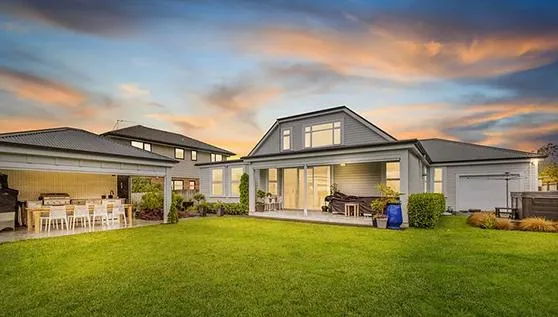
Sky replacement. Auckland weather is unpredictable. A professional photographer replaces overcast skies with natural-looking blue skies in post-production as a standard part of their workflow — not as a paid add-on.
Spot and object removal. Minor imperfections — a dust mark on a ceiling, a visible power cable, a stray item missed during preparation — should be cleaned up in editing without you having to ask.
Related: For a full explanation of HDR, hand-blending, sky replacement, and other editing terms, see our photography glossary below
Evaluate the photography style
Not all professional real estate photography looks the same. Some photographers produce warm, natural-toned images. Others lean towards bright, high-contrast HDR. Some use flash extensively; others work exclusively with natural light and exposure blending.
None of these styles is objectively better than the others — but you need to know what you are getting and whether it matches the standard you want across your listings. Look at the photographer’s portfolio and ask yourself: does every property look like it was shot by the same person with a consistent approach? Consistency matters more than any single spectacular image, because your brand is built across dozens of listings, not one.
A good photographer should be able to articulate their style clearly and explain why they use the techniques they do. If they cannot explain the difference between flash photography and HDR hand-blending, or why they choose one over the other, that tells you something about how intentional their process is.
Ask about lighting technique
Lighting is where the technical quality of real estate photography is most visible. The two most common approaches are flash photography and HDR hand-blending.
Flash photography adds artificial light to a scene using external flash units. Done well, it produces bright, clean images. Done poorly, it creates harsh shadows cast from low angles, unnatural colour temperatures, and a clinical feel that makes rooms look like a hospital corridor rather than a home.
HDR hand-blending uses multiple exposures of natural and ambient light, blended together in editing. The result tends to feel warmer, more natural, and closer to how the room actually looks when you stand in it. This is the technique most professional real estate photographers in Auckland use as their default.
When evaluating a photographer’s work, look for shadows. In a well-lit HDR image, shadows are soft and natural. In a poorly executed flash image, shadows go in multiple directions and are cast from low angles — a telltale sign of on-camera or single-point flash. If the images feel artificial or flat, the lighting technique is likely the reason.
Check turnaround time and delivery
In real estate, timing matters. Your vendor wants the listing live as soon as possible. Your marketing campaign has a launch date. Your print deadlines do not wait for a photographer who is running behind.
Ask the photographer what their standard turnaround time is and whether it is guaranteed. The industry standard for Auckland real estate photography is 24-hour turnaround for edited photos and floor plans, though some photographers take 48–72 hours or longer.
Also ask what happens if you need to reschedule. Auckland weather can change the morning of a shoot. A photographer who charges rescheduling fees or cancellation fees adds friction and cost to a process that is already unpredictable. The best photographers absorb this because they would rather wait for the right conditions and deliver strong images than shoot in the rain and deliver compromised ones.
Related: For tips on what to prepare before the photographer arrives, see our shoot-day preparation guide below.
Look for pricing transparency
If a photographer does not publish their pricing, ask yourself why. Hidden pricing usually means one of two things: the prices change depending on the client, or the photographer does not want to be compared directly against competitors.
Transparent pricing allows you to see exactly what you are getting before you book. It removes the back-and-forth of requesting quotes, and it builds trust — both between you and the photographer, and between you and your vendor when you present the marketing costs.
When comparing pricing, look at what is included in the base package rather than just the headline number. Some photographers quote a low base price but charge extra for aerial photography, floor plans, sky replacement, or even high-resolution file delivery. Others bundle everything together so you know exactly what you are paying for upfront and to avoid having you present vendors with too many options and add-ons.
See pricing: View Bash & Co’s full packages and pricing at bashco.co.nz/pricing
Check what is included as standard
The services bundled into a listing package vary significantly between photographers. Before you compare prices, make sure you are comparing like for like. Here is what to check:
Aerial photography. Some photographers include drone shots in every package. Others charge it as a separate add-on. For most Auckland listings, aerial photography adds genuine value — showing boundary lines, neighbourhood context, and proximity to amenities that ground-level photos cannot communicate.
Floor plans. A floor plan is one of the most useful assets in a listing for helping buyers understand layout and flow. Check whether it is included or charged separately, and whether it is a basic outline or a detailed, furnished plan.
Number of images. Ask how many edited images are included. Some photographers cap the number of images per shoot, while others deliver everything that meets their quality standard.
Licensing and usage rights. Confirm that you have unlimited licensing to use the images across all platforms — Trade Me, homes.co.nz, realestate.co.nz, print brochures, social media, email campaigns. Some photographers restrict usage or charge extra for certain platforms.
File formats and resolution. You should receive both high-resolution files (for print) and web-ready versions (for online listings). Check that both are included as standard.
Assess communication and flexibility
The quality of the images is only part of the experience. How the photographer communicates, how they handle changes, and how easy they are to work with over dozens of listings matters just as much.
A good real estate photographer operates like an extension of your team. They understand your schedule, they are responsive to changes, and they make the process seamless for both you and your vendor. They do not create additional admin for you — they reduce it.
When evaluating this, look for:
Booking simplicity. Can you book online in under a minute, or do you need to email back and forth? The best systems let you select your services, pick a time, enter the property address, and confirm — done.
Rescheduling policy. Do they charge for weather-related rescheduling? Do they accommodate last-minute vendor changes? Flexibility here signals a photographer who understands how real estate actually works.
Vendor communication when you need it. There will be times when you are pulled into something urgent and cannot be at the shoot. A good photographer is comfortable dealing directly with the vendor if needed — confirming the appointment, walking through preparation on arrival, and managing on-site logistics without you having to be there. This is not the standard, but it should be an option when you need it.
The bottom line
Choosing a real estate photographer is not a one-off decision — it is a relationship that affects every listing you bring to market. The right photographer makes you look good to your vendors, helps your listings stand out on Trade Me and realestate.co.nz, and removes friction from the listing process. The wrong one costs you time, creates inconsistency, and quietly undermines the brand you are trying to build.
Evaluate the portfolio, ask the right questions about technique and process, check the turnaround and pricing, and make sure the full package actually covers what you need. Then test the relationship with one listing and see how it feels.
Ready to see the difference? View our photography services to see how Bash & Co handles HDR, aerial, and virtual twilight for Auckland listings. Or check our packages and pricing to see exactly what is included at every level.
Frequently asked questions
How much does a real estate photographer cost in Auckland?
A standard listing photography package in Auckland typically costs between $400 and $700+ GST, depending on the size of the property and what is included. Prices vary based on the number of services bundled (photography, aerial, floor plan, video, virtual twilight). Look for transparent pricing that shows exactly what is included rather than a base price with add-ons.
How do I know if a real estate photographer is any good?
Look at their portfolio for consistency: straight vertical lines, balanced exposure in every room, clean exteriors with sky replacement, and a range of property types. Ask about their editing technique — HDR hand-blending produces more natural results than automated processing or poorly executed flash. Check turnaround times and read Google reviews from other agents, not just homeowners.
Should I use the same photographer for every listing?
In most cases, yes. Consistency across your listings builds your brand as an agent. When every property you market is presented to the same standard, vendors see that consistency and associate it with your professionalism. Switching photographers between listings often results in inconsistent image quality and style.
What is the difference between HDR photography and flash photography?
HDR photography blends multiple exposures of natural light to create a balanced image. Flash photography adds artificial light to the scene. HDR tends to produce warmer, more natural-looking results. Flash can look artificial if not executed carefully. Most professional real estate photographers in Auckland use HDR hand-blending as their default technique.
How quickly should I expect photos back after a shoot?
The industry standard for Auckland real estate photography is 24-hour turnaround for edited photos and 2D floor plans. Some photographers take 48–72 hours. If turnaround time is important to your listing timeline, confirm the guarantee before you book and ask whether it applies 7 days a week or only on business days.