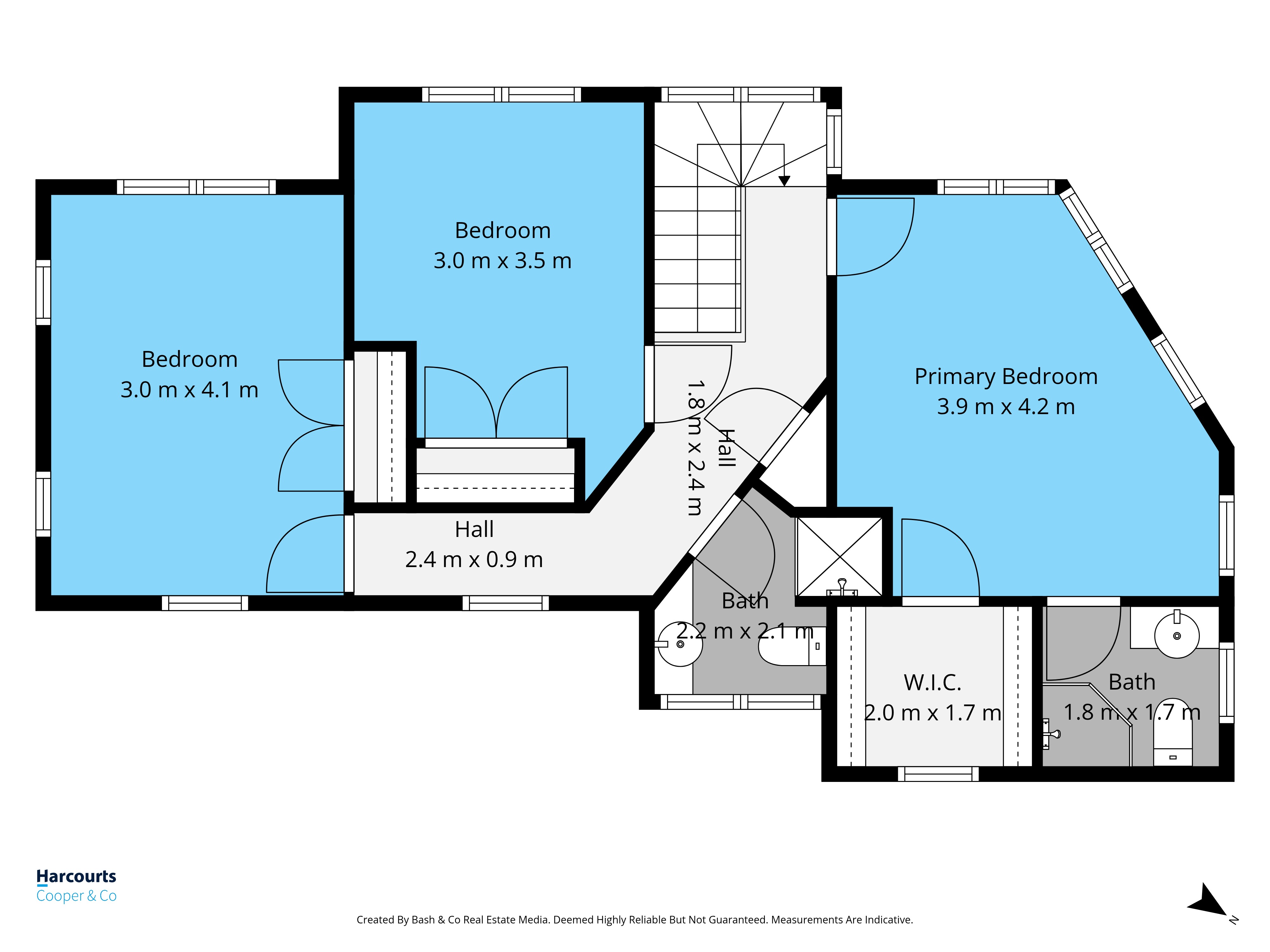
How to Read a Floor Plan: Symbols, Scale and Dimensions
A floor plan tells you more about a property than any photograph will. Photos show you how rooms look. A floor plan shows you how the house works: whether the bedrooms are separated from the living space, whether you walk through one room to reach another, whether the kitchen actually opens onto the deck the listing mentions.
I draw floor plans for Auckland listings, and the thing I notice is how many people scroll straight past them. Usually because nobody has ever explained what they're looking at.
Once you can read one, you can rule properties in or out in minutes without setting foot inside. Here's how.
Start with orientation and scale
Two things sit on almost every floor plan and most people skip both.
The north arrow tells you which rooms get sun. In New Zealand, north-facing living areas get sun through the middle of the day, and south-facing rooms stay cold. Rotate the plan in your head so north faces away from you, then look at where the living areas and the largest windows sit. This one symbol answers a question a whole gallery of photographs won't.
The scale tells you whether the drawing is proportional. Most residential plans are drawn at 1:100, so one centimetre on the page is one metre in the house. If a plan says "not to scale", treat the shapes as indicative and rely on the written dimensions instead.
How dimensions are written
Room dimensions are given as two numbers, like 4.2 × 3.6. In New Zealand these are metres, and the convention is width first, then length, width being the wall you face as you enter the room.
That convention is not universal and it is not enforced. Plenty of plans list the longer dimension first regardless. If the difference matters to you, and it will if you're fitting a bed or a dining table, check the drawing rather than trusting the order of the numbers.
A quick reference for what those numbers mean in practice:
Watch the narrow rooms. A room listed as 2.2 × 5.5 has a respectable 12 m² on paper but is too narrow to put a double bed and a wardrobe side by side. Always read both numbers, never just the area.
Make the numbers real before you visit
The most useful five minutes you can spend: walk the dimensions out in your current home. If the main bedroom is 4.2 × 3.8, pace that out where you live now and see where the walls would fall. It saves more disappointment than any number of open home visits.
It helps to know what your own furniture measures. A queen bed is about 1.5 × 2.0 m. A three-seat sofa runs 2.0–2.4 m. A dining table for six needs roughly 1.0 × 2.0 m plus room to pull the chairs out. If a bedroom is 3.6 m wide and the bed takes 1.5 m, you have 2.1 m left to split between a walkway and storage.
Does floor area include the walls?
Yes — and knowing that explains a lot of confusing listings.
New Zealand has an agreed standard for measuring homes: the Guide for the Measurement of Residential Properties, published jointly by Property Council New Zealand and the Property Institute of New Zealand. It broadly follows the international residential standard, IPMS 3A.
Under it, a property is measured to the external face of the external walls, and to the centre line of shared walls in townhouses and apartments. Measurements are taken at 1.5 metres above floor level.
So the headline floor area on a listing includes the thickness of the walls. It is the footprint of the building, not the sum of the space inside it.
Why the rooms never add up to the total
Room dimensions are a different measurement. Those are taken inside the room, wall to wall.
Add up every room on a plan and you will always land short of the headline figure. The gap is the walls themselves plus the circulation space — hallways, stairwells, the width of every doorway.
That gap is wider in a house chopped into many small rooms than in an open-plan one of the same footprint. It is why two 150 m² homes can feel completely different to walk through, and why price per square metre is a blunter comparison than it looks.
What's counted separately
The standard includes these in the measurement but requires them to be stated separately rather than folded into the main figure:
Balconies and decks, enclosed or otherwise
Verandas and pergolas
Garages and carports
Attics
So a listing advertising "180 m²" may mean 180 m² of house, or 180 m² with a deck and a garage inside the number. If the square meterage looks generous for the number of bedrooms, that is usually why. Ask which it is before you compare it against anything.
What the symbols mean
The one worth paying attention to is the door swing arc. It tells you where a door opens into a room, which determines where furniture can't go. A bedroom that looks fine on paper can lose its only sensible bed wall to a door that opens the wrong way.
Reading the layout, not just the rooms
Once you can read the parts, read how they connect. Four things I'd look for:
Circulation. Trace the path from the front door to the kitchen, and from the main bedroom to the bathroom. If you pass through a living space to reach a bedroom, that's a compromise you'll live with daily.
Bedroom separation. Are the bedrooms grouped, or is one isolated? Matters for families, flatmates, and anyone working from home.
Indoor-outdoor flow. Look for doors from living areas to a deck or patio. Listings claim this constantly; the floor plan is where you verify it. If the only route outside runs through a hallway or the laundry, the connection is limited no matter how good the outdoor area looks in the photos.
Wall thickness. Thicker lines usually mean load-bearing walls. If you're thinking about opening up a space later, those are the expensive ones.
What the plan shows that the photos don't
Photography is shot at the best angle, in the best light, on the widest lens that flatters the room. A floor plan can't flatter anything — it's a scaled drawing. That makes it the best place to spot the things worth asking about.
A bedroom sharing a wall with the living area or kitchen. The plan shows exactly which walls are shared. Noise transfer is invisible in photos and obvious here.
A bathroom with no window symbol. It relies entirely on mechanical ventilation. Common in apartments and townhouses, not necessarily a problem, but worth knowing.
A main bathroom reachable only through the main bedroom. Shows up as a bathroom with one door, opening off the bedroom. Daily life with that layout is genuinely different.
A long entry hallway. Hallways are counted in the total floor area but don't function as a room. If a chunk of the square meterage is corridor, the plan is where you'll see it.
No door from the living area to outside. Whatever the listing says about indoor-outdoor flow.
Reading a two-storey plan
Two-storey properties are drawn as two separate overhead views, one per level, usually labelled Ground Floor and First Floor.
Use the staircase as your anchor. It appears on both plans, in the same position. Line the two levels up on the stairs and you can see which rooms sit directly above which — and whether the upstairs bedrooms are over the living room, which tells you what you'll hear in the evening.
2D, 3D and interactive plans
Most listings carry a 2D plan — the schematic this guide has been describing. It's the most useful format for checking dimensions and layout because it's precise and drawn to scale.
A 3D plan renders the same layout with virtual furniture, flooring and textures. Easier to picture, less useful for verifying measurements. Use the 3D version for the feel of the place and the 2D version to check the numbers.
An interactive floor plan tour links each room on the plan to the actual listing photo taken from that position. If a listing has one, use it before the open home — it answers the questions the plan raises and the photos on their own can't.
What floor plans don't tell you
They flatten some things worth knowing.
Ceiling height rarely appears, and it changes how a room feels more than its footprint does.
Level changes. A step down into a living room may show only as a thin line.
Outlook. A 4 × 4 bedroom facing a fence and one facing a garden read identically on a plan.
Condition. A floor plan is geometry, not a report on the state of anything.
Use the plan to understand the layout, the photos to understand the feel, and a viewing to check everything neither one showed you.
Need a floor plan for a listing? See real estate floor plans in Auckland · 2D vs 3D floor plans compared
Frequently asked questions
Are floor plan dimensions width or length first?
Convention in New Zealand is width first, then length. It isn't a rule, so check the drawing where it matters.
Is floor area measured inside or outside the walls?
Outside. Under the New Zealand measurement standard the area is taken to the external face of the external walls, and to the centre line of shared walls in townhouses and apartments — so wall thickness sits inside the figure. Individual room dimensions are measured inside the room, which is why the rooms never add up to the total.
What scale are residential floor plans drawn at?
Usually 1:100, so one centimetre represents one metre.
Do floor plans include the garage?
Usually shown, but quoted separately from the main floor area. Decks, balconies and verandas are also identified separately under the measurement standard.
How accurate are the dimensions on a marketing floor plan?
Professional plans produced with laser measurement or scanning tools are accurate to within about 1% for most residential properties. The standard "measurements indicative only" disclaimer exists because they're drawn for marketing, not for construction or legal use. For deciding whether a room is big enough, they're reliable. For planning exact furniture placement, measure the room at the open home.
What if the listing doesn't have a floor plan?
Ask the listing agent for one. It's a reasonable and common request. If none exists, that's worth noting in itself — a listing without a plan reflects either a gap in the marketing or an unusual layout, and both are worth clarifying before you spend an afternoon on a viewing.
Should a listing have a floor plan?
Yes. Listings with floor plans get more enquiries because buyers can answer the layout question themselves rather than guessing. More on why every listing needs one.