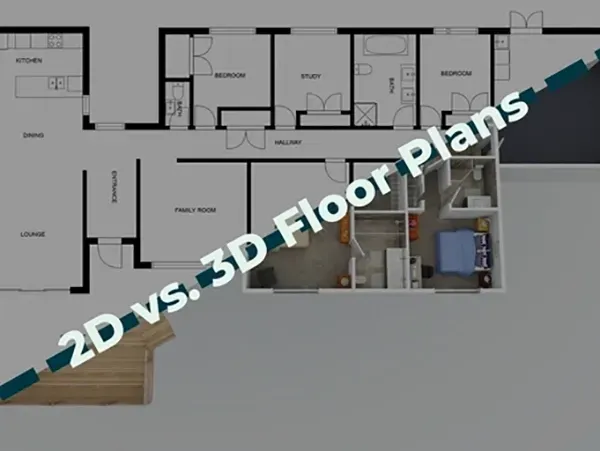
2D vs 3D Floor Plans: Which Does Your Listing Need?
Every Auckland agent knows the question. You are putting a listing together, the property has potential, and you are deciding what floor plan to include. The 2D plan is standard and fast. The 3D plan looks impressive. But which one does more work for this particular listing?
The honest answer is that it depends on the property, which is only useful if you have a clear way to decide. This guide gives you that. By the end you will know when 2D is the right call, when 3D earns its cost, and when neither is the floor plan question you should really be asking.
What is a 2D floor plan?
A 2D floor plan is a clean overhead schematic of a property. It shows every room, the dimensions of each space in metres, how the rooms connect, where fixtures and cabinetry sit, the total square meterage, and the property's north orientation. It is the standard format across New Zealand listings and the one buyers know best.
A professional 2D floor plan is branded to your agency and delivered within 24 hours of the shoot. It answers the practical layout questions buyers have before they visit: the room sizes, the flow, where everything sits. Photos cannot answer those, however good they are. For a breakdown of how buyers actually read these plans, see our guide on how to read a real estate floor plan.
Zillow's research found that 82% of buyers are more likely to view a property when the listing includes a floor plan they like. The 2D plan is how most listings deliver that.
What is a 3D floor plan?
A 3D floor plan starts from the same scan and the same measurements as the 2D version. The difference is the output. Where the 2D plan gives buyers a schematic to read, the 3D plan renders the space with virtual furniture, flooring, wall colours and textures, so buyers see a furnished home rather than an empty diagram.
That changes how buyers engage. They stop working out whether a room is big enough and start picturing whether it suits them, which is what brings them to the open home closer to a decision.
When a 2D floor plan is the right choice
For most Auckland listings, a 2D floor plan is the right call. Here is when it is clearly enough.
The property is well-presented and occupied. If the home is furnished, styled and photographed well, buyers can already picture themselves there. The 2D plan adds the dimensional layer the photos cannot show: layout, flow and size. That is all it needs to do.
The listing sits in a standard price bracket. For properties up to around $1.2 to $1.5 million, a 2D plan is what buyers expect. A 3D version does not change the appeal of a straightforward family home.
Budget is a real consideration. If you are managing a vendor's marketing spend, the 2D floor plan included in the standard package covers what you need without an extra cost conversation.
When a 3D floor plan earns its cost
A few listing scenarios call for what a 3D floor plan can do that a 2D plan cannot.
The property is vacant or emptied. An empty home is the hardest thing to photograph well and the hardest for buyers to connect with, since empty rooms look smaller than they are. A 3D floor plan furnishes the whole space virtually, giving buyers a furnished view without the cost or time of physical staging.
The property is tenanted or full of difficult furniture. If the current furniture is old, cluttered or badly placed, a 3D floor plan can replace it with a clean default set. Buyers see the property at its potential rather than its current state.
The property is premium or luxury. At higher price points, buyers expect more from the marketing. A 3D floor plan matches that, and shows the vendor you are taking their listing seriously.
The listing is a new build or off-the-plan. Here, 3D is the only real option. If the property isn't built, there is nothing to photograph. A 3D floor plan produced from the architectural plans gives buyers a furnished, realistic view of what they are buying, and paired with a 3D video render it builds a full marketing picture before a single brick is laid.
The third option most agents are not using yet
Both the 2D and 3D floor plan are static images. The third option takes the 2D floor plan and turns it into something buyers can explore.
At Bash & Co, when you book photography and a 2D floor plan together, your listing gets an interactive floor plan tour. Buyers open a link on any device and see the property's floor plan. They click any room, any point on the plan, and the actual listing photo taken from that position appears. They move through the property space by space, seeing what is visible from each spot, with the floor plan always beside them.
It is generated automatically from your listing photos and the floor plan scan, not from a 360-degree camera or a separate shoot. The result is that more buyers reach the open home having already walked the property online.
realestate.co.nz and Harcourts listings support embedding the link directly. For Trade Me and other agency platforms, it pastes in as a URL in the listing description.
It is a genuine point of difference in the Auckland market, and it costs nothing extra when you book photography and a 2D floor plan together at Bash & Co.
A simple decision framework
Still unsure which fits your listing? Use this as your guide.
Choose a 2D floor plan if the property is occupied and well-presented, sits in a standard price bracket, and your aim is giving buyers the layout they need to qualify themselves before the open home. Book photography alongside it and the interactive floor plan tour comes free, giving buyers a clickable, photo-linked walk through the property.
Choose a 3D floor plan if the property is vacant, tenanted with difficult furniture, premium or luxury, or a new build or off-the-plan development where photos cannot capture the finished home. The interactive tour does not apply here, since it needs real listing photos to generate.
Either way, the floor plan itself is not optional. It is the standard buyers now expect.
The bottom line
The real question is not 2D versus 3D. Both are professional and both do a specific job well. The question is whether you are including a floor plan at all, because the data is clear on what happens when you do not.
According to Rightmove, one in five buyers will ignore a listing with no floor plan, listings with one get 52% more click-throughs, and 42% said they would not hire an agent who does not provide a floor plan as part of their marketing.
In a competitive Auckland market, that is the difference between a listing that earns enquiries and one that gets scrolled past.
Every Bash & Co listing package includes a 2D floor plan and an interactive floor plan tour as standard when booked with photography, with 3D floor plans available to add when a property needs more. Read more about our real estate floor plan services and packages and pricing.
Frequently asked questions
Is a 3D floor plan worth the extra cost for a standard Auckland listing?
For most standard residential listings, no. A professional 2D floor plan gives buyers what they need to understand the layout, qualify themselves, and arrive at the open home informed. The 3D floor plan earns its cost for vacant properties, tenanted homes with poor presentation, premium listings, and new builds where photography alone cannot convey the finished space.
Can buyers tell the difference between a 2D and a 3D floor plan?
Yes, immediately. A 2D floor plan is a schematic: a clean overhead diagram showing rooms, dimensions and fixtures. A 3D floor plan renders the same layout with furniture, flooring, colours and textures, so it looks like a realistic bird's-eye view of a furnished home. The 2D answers practical questions; the 3D helps buyers connect with the space.
What is an interactive floor plan tour and how does it work?
It is generated when photography and a 2D floor plan are booked together. It produces a shareable link where buyers view the floor plan and click any point to see the actual listing photo taken from that position. It works on any device, needs no app, and is included at no extra cost with photography and floor plan orders at Bash & Co.
Does the interactive floor plan tour work with 3D floor plans?
No. The interactive tour is only available when photography and a 2D floor plan are ordered together, because it maps your real listing photos to positions on the plan. It does not apply to 3D floor plans, which are used for vacant, tenanted or off-the-plan properties where standard photography may not exist or may not represent the finished home.
Which floor plan type is best for a new build or off-the-plan development in Auckland?
For new builds and off-the-plan properties, a 3D floor plan or 3D video render is the only viable option. There is nothing to photograph until the property is built, so a virtually furnished 3D floor plan produced from the architectural plans gives buyers a realistic view of the finished home. The interactive tour is not available for new builds, as it needs real listing photos.
How do I add a floor plan to my Trade Me or realestate.co.nz listing?
For realestate.co.nz, the interactive floor plan tour link can be embedded directly via the agent portal. For Trade Me Property, paste the link into the listing description: Trade Me does not support direct embedding, but the link still works. Harcourts listings support direct embedding, and most major Auckland agencies including Ray White and Bayleys have a virtual tour or media URL field where the link can go.