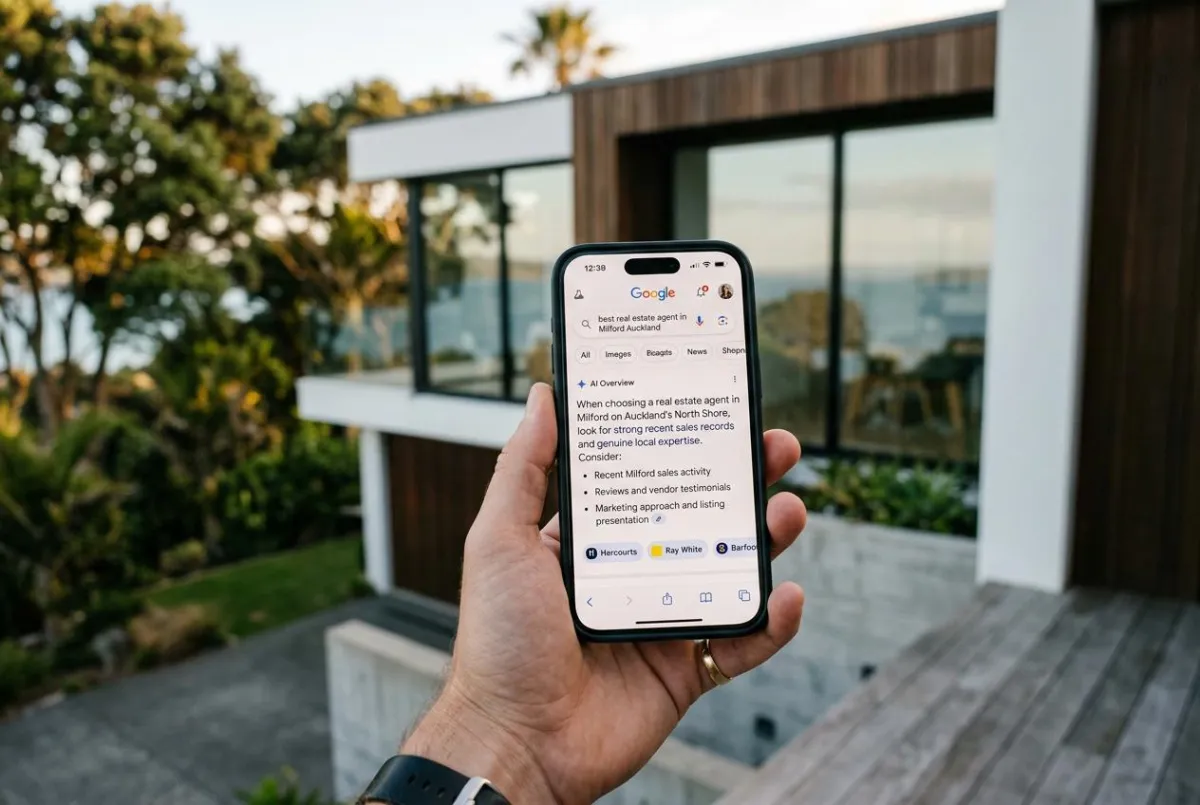
AI Search for NZ Real Estate Agents in 2026
AI search is now live across New Zealand. Google AI Overviews appear on nearly half of all searches. ChatGPT, Perplexity, and Google's new AI Mode are answering buyer and vendor questions before agents' websites get a single click. The agents who win now are the ones cited inside those AI answers.
What changed: from SGE to AI Overviews to AI Mode
If you read anything about "SGE" or "Search Generative Experience" in 2024, that product no longer exists by that name. Google rebranded SGE to AI Overviews on 14 May 2024 and rolled it into mainstream search. Three things have happened since:
AI Overviews now appear on around 48% of all Google searches globally (up from 6.49% a year earlier — a 58% year-on-year increase). They are live in New Zealand and across more than 200 countries.
Google AI Mode launched in New Zealand in January 2026. It lets users ask multi-step questions and follow up conversationally — like a Google-built ChatGPT. Blue links get pushed further down the page.
Ad-enabled AI Overviews rolled out to NZ in December 2025. Google can now show paid placements directly inside AI answers, alongside organic citations.
The combined effect: a buyer searching "best real estate agent in Devonport" or a vendor searching "is now a good time to sell in West Auckland" gets a synthesised answer, citing whichever sites Google's AI judged most authoritative. Often that synthesised answer is enough — and the search ends there.
AIO, GEO, LLMO — the terms, simplified
Three acronyms now sit alongside SEO. They overlap heavily. The shortest version of each:
SEO — Search Engine Optimisation
The original. Optimising your site to rank in Google's traditional ten-blue-link results. Still matters — about 52% of queries still return no AI Overview. SEO is the foundation everything else is built on.
AIO — AI Optimisation
The umbrella term. Anything you do to make your content visible inside AI-powered answers, whether that's Google AI Overviews, ChatGPT, Perplexity, Microsoft Copilot, or AI Mode.
GEO — Generative Engine Optimisation
A near-synonym for AIO. Most strategists use GEO to describe optimising for the actual AI engines — Google's Gemini, OpenAI's ChatGPT, Anthropic's Claude, Perplexity's mixed model — rather than for any one product. If a piece of content can be cited by any of them, it has been optimised for GEO.
LLMO — Large Language Model Optimisation
The most technical of the four. Focuses on making content quotable by the underlying language models through schema markup, entity linking, citation-ready snippets, and clean semantic HTML.
If you only remember one thing
AIO, GEO, and LLMO mostly describe the same job: get cited by AI engines instead of just ranking on Google. The tactics overlap. The terminology is unsettled and will keep shifting through 2026 and 2027.
Why this matters for real estate agents in New Zealand
Real estate is one of the most AI-search-affected industries in NZ for three reasons.
Buyers now ask AI before they ask agents
A buyer who would have spent two hours on Trade Me three years ago now starts on ChatGPT. Queries like "What are the best family suburbs in Auckland's North Shore for under $1.5m?" or "Compare Hobsonville Point and Beach Haven for first home buyers" return a full briefing in seconds — pulled from agency sites, blog posts, OneRoof articles, and Reddit threads.
Vendors research agents the same way
"Who is the best real estate agent in Milford?" produces an AI-generated comparison with named agents and pull-quotes. The agents that get cited are the ones with substantive web presence — bios with real credentials, recent reviews, original content, and consistent NSAP signals (name, agency, address, phone) across the web.
Local intent is still under-served
AI engines hunger for locally-grounded content because most of what's on the web is generic. Suburb-specific pages — North Shore family suburbs, Hibiscus Coast lifestyle, West Auckland first-home guides — currently have almost no Auckland real estate competitors writing them. The first agency to systematically build out suburb content owns those AI citations for years.
How AI search actually picks who to cite
This is where most agents get it wrong. AI engines do not pick the same sources as Google's classic ranking algorithm. Research from Authoritas analysing 1,000 commercial queries found that 93.8% of websites cited inside AI Overviews come from outside the first page of standard search results. Different game, different rules.
What AI engines reward
Five things AI engines reward consistently across Google AI Overviews, ChatGPT, and Perplexity:
A direct answer in the first paragraph after each heading. Crawlers scan headings, then read the first 40-60 words. Bury the answer below filler and the page does not get cited.
Original information. Data you collected, photography you shot, commentary you wrote yourself. Regurgitated content gets de-ranked because the AI detects zero new information.
Schema markup. FAQPage, LocalBusiness, Person, Service, Article. Sites with proper schema are cited at substantially higher rates than sites without.
Authority signals. A real author bio with credentials, links to LinkedIn, mentions on third-party sites like REINZ and OneRoof, podcast appearances, and consistent business data across the web.
Reviews. The wording inside review text often gets quoted directly in AI answers, so reviews now do double duty as content and trust signal.
What AI engines penalise
Generic AI-written content with no first-hand experience
Keyword-stuffed pages that don't answer a question
Hidden pricing. AI engines treat "contact for quote" as a negative signal compared to transparent pricing
Slow page response times. AI crawlers behave like power users and abandon slow pages
Sites with no author identity or credentials attached
7 things NZ real estate agents should do right now
This list is in order. Start at the top, work down. Most agents are doing zero of these. Doing three would put a North Shore agent ahead of every competitor in their patch within 90 days.
Audit how you appear in AI search today. Type your name, your agency, and your suburb into ChatGPT, Perplexity, and Google AI Overviews. Read what comes back. Note who gets cited. That is your starting position. Repeat monthly.
Restructure your bio and listings page with question-format headings. Replace "About Me" with H2s like "Who is [agent name]?", "How long has [agent name] worked on the North Shore?", "What suburbs does [agent name] specialise in?". Each one followed by a 40-word direct answer. AI engines lift these almost verbatim.
Build a real, substantive bio with proof points. Years in industry, suburbs covered, sales record, agency, REINZ membership, certifications. AI engines need entities to cite. Vague bios — "passionate about helping families" — are useless to them and to vendors.
Get cited on third-party NZ sites. Agency profile, OneRoof contributor profile, LinkedIn, local podcast appearances, REINZ. Every external mention with consistent business data strengthens the entity an AI engine knows as you.
Add proper schema markup to every page. LocalBusiness on the homepage. Person on the bio page. FAQPage on every page with Q&As. Service on each service page. BreadcrumbList everywhere. The GHL Schema Markup panel handles this without code touching the page body.
Publish suburb-level content with original local data. One in-depth post per suburb you cover, with median prices, days-on-market, school zoning, transport, and your own commentary. No competitor in Auckland real estate media is doing this systematically as of mid-2026 — the first to do it owns the AI citations for those suburbs.
Treat reviews and testimonials as ranking signals. Ask every successful vendor for a Google review. Get quotes you can publish on the site. The exact wording in those reviews shows up in AI Overviews when buyers ask "who is good in [suburb]".
Common mistakes that kill AI search visibility
Five mistakes that kill AI search visibility for agents:
Publishing AI-written content as-is. AI engines detect zero information gain and stop citing the page. Use AI to draft, then rewrite in your own voice with original data.
Hiding behind "contact for a quote". Opaque pricing reads as a trust failure to AI engines. Transparent pricing gets quoted directly in AI answers.
Treating the website as a brochure. An About page of marketing fluff gives an AI engine nothing to extract.
Ignoring schema markup. It costs nothing to add and increases citation rates substantially.
Year-stamping content and never refreshing it. An article called "Best North Shore Suburbs 2024" still live in 2026 tells Google and AI engines the site is abandoned.
Frequently asked questions
Is AI search live in New Zealand?
Yes. Google AI Overviews have been live in NZ since late 2024. Google AI Mode launched in NZ in January 2026. Ad-enabled AI Overviews rolled out in NZ in December 2025. ChatGPT, Perplexity, and Microsoft Copilot are all freely accessible to New Zealand users.
Should real estate agents stop doing SEO?
No. Around 52% of Google searches still return no AI Overview, which means traditional SEO still drives the majority of organic traffic. SEO is the foundation. AI optimisation is the addition. The agents who win are doing both.
How do I check whether I appear in AI search?
Open ChatGPT, Perplexity, and Google AI Overviews in incognito mode. Search your name, your agency, and your suburbs. Note which sources are cited and which aren't. Repeat the audit monthly. There are paid tools like Profound and Otterly emerging for this, but manual checks still cover most use cases.
Does schema markup actually help with AI search?
Yes — substantially. Schema markup tells AI engines exactly what each block of content is (a question, an answer, a business, a person, a service). Sites with FAQPage and LocalBusiness schema get cited in AI Overviews at notably higher rates than sites without. Schema is the cheapest single change with the biggest visibility impact.
Will AI search replace real estate agents?
No. AI search will replace the early-funnel research stage — the bit where buyers and vendors used to spend hours on Google. The transactional, judgement-led, relationship-driven part of an agent's job is unaffected. What changes is which agents get the call. The ones cited inside AI answers will get more enquiries; the ones invisible to AI will get fewer.
How long until AI search optimisation pays off?
Faster than traditional SEO. Because AI engines cite content that wouldn't necessarily rank on page one of Google, a well-structured new page with proper schema and original data can get cited within weeks. The compounding gains take 6–9 months as authority signals accumulate.
Where Bash & Co fits in
All of the above — author bios, schema, suburb content, FAQ structure, transparent pricing, real reviews — points in one direction. Websites that work as substantive media outlets get cited by AI engines. Websites built as digital brochures don't.
That's the foundation of the personal branding work Bash & Co does for North Shore agents: photography, video, bios, and content that AI engines can quote and vendors can trust.
If you want to see how your AI-search footprint looks today and where the gaps are, get in touch. Free audits for North Shore agents on request.